File Intelligence
Your work arrives as email, PDFs, scans, drawings, and spreadsheets. Vsimple reads all of it and turns it into something your team and your agents can act on.

Join the companies already growing with Vsimple

Read anything that arrives
The problem was never storage. Your files are already somewhere. The problem is that a person has to open each one to find out what it says.
Email and everything attached
The message body, the forwarded thread underneath it, and the three files stapled to the bottom.
PDFs and scans
Native PDFs, scanned paper, phone photos of a signed form, and faxes that are still somehow faxes.
Drawings and specs
Pull the model numbers, dimensions, and configuration details out of the documents your team already works from.
Turn the file into fields
Reading is not enough. The output has to be structured, or a person is still the one moving data from the document into the system.
Line items and quantities
Part numbers, descriptions, quantities, unit pricing, and extended totals, pulled into fields.
Terms, dates, and addresses
Ship-to, bill-to, requested dates, freight terms, and payment terms, wherever they happen to sit on the page.
Layouts that keep changing
Every customer formats a PO differently, and most change it without telling anyone. The fields still get found.
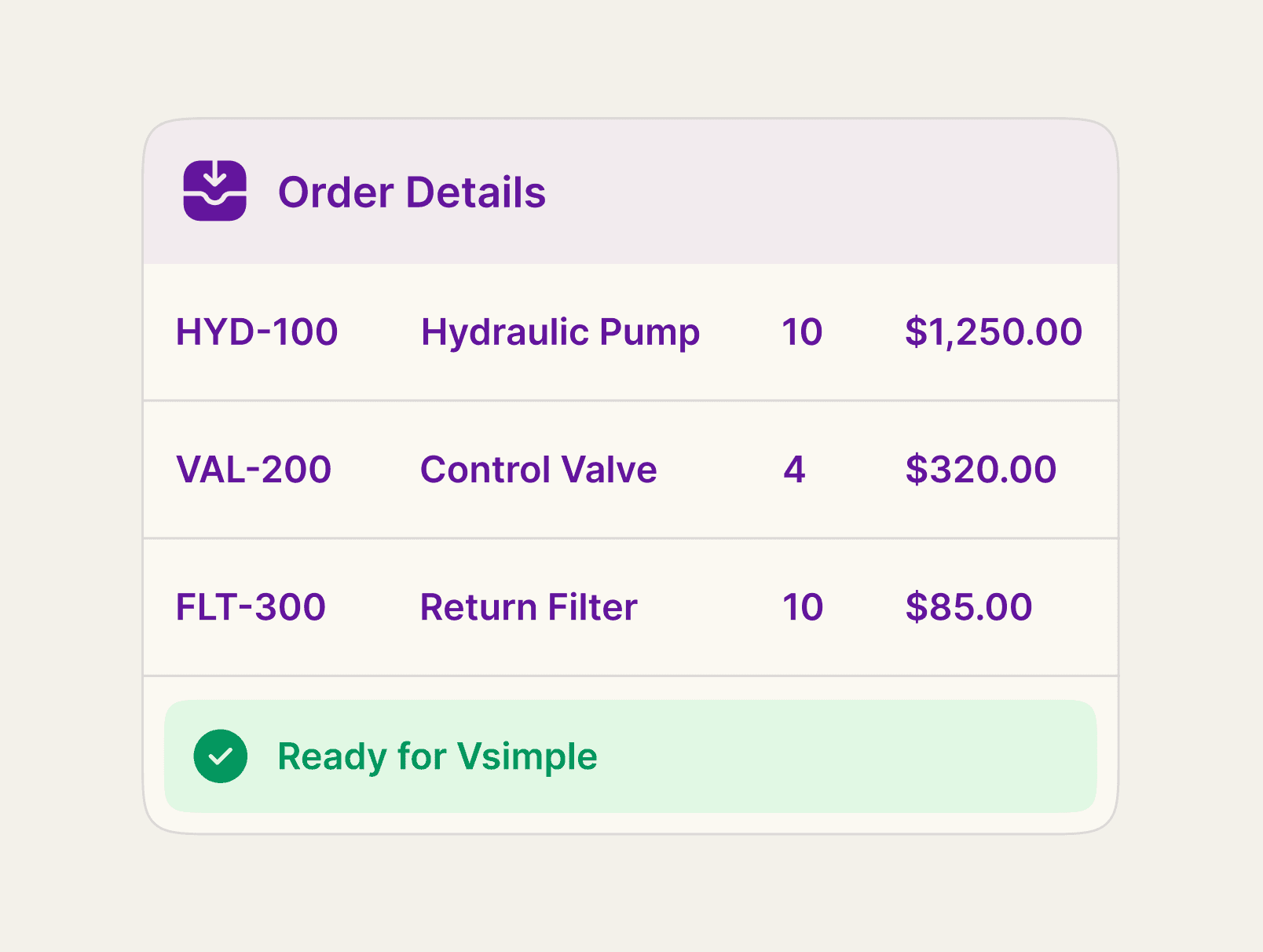

Check it before it moves
Extraction that nobody verifies is just faster data entry with new errors. What comes out of the document gets compared to what you already have.
Against the quote
Line items, pricing, and quantities checked against what was quoted, so a mismatch surfaces at intake.
Against your catalog
Parts that do not exist, discontinued items, and configurations that do not go together get flagged.
What is missing
The original document stays with the record, so the person approving can see exactly what it came from.

Documents
A PO lands as a PDF, gets read against the quote, and arrives staged for approval instead of retyped.
A request buried in a forwarded thread becomes a structured quote to price instead of a message to read.
An order written entirely in the customer's own numbering gets matched to your catalog before anyone touches it.
A spreadsheet with three hundred lines becomes an order without three hundred manual entries.
A scanned signature page gets read, matched to the job, and filed against the record it belongs to.
Photos and notes captured on site get attached to the job, so office staff are not chasing them later.